2026 Pre-Seeding Crop Report
2026 Pre-Seeding Crop Report – Oat and Pulse Market
From the desk of Mike Gallais, Director of Procurement
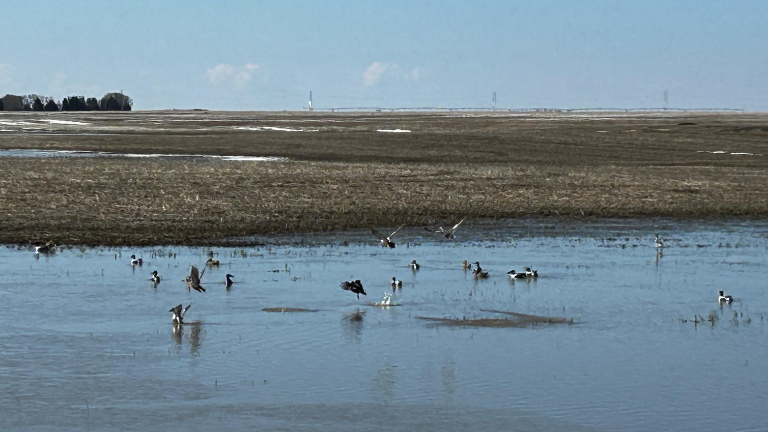
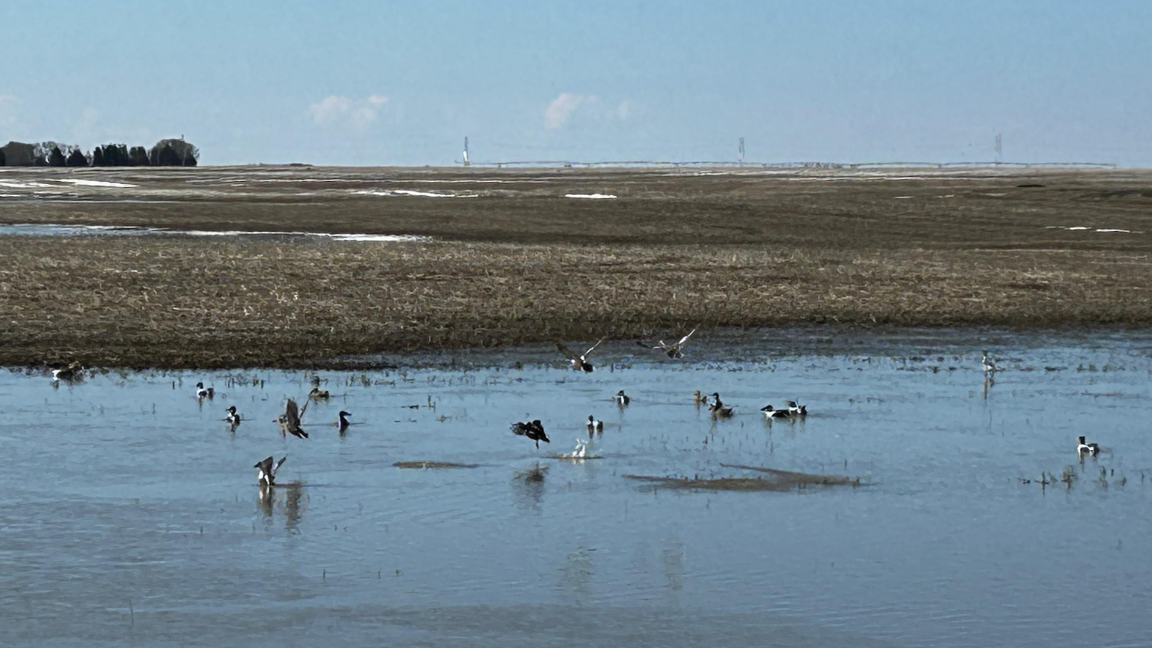
Seeding feels a long way off still as weather systems continue to dump snow through areas of Saskatchewan. In southern areas, the wintery landscapes disappear as quickly as they arrive, but in the northern part of the province, it is another story. The snow hasn’t yet started to melt and with fresh snow arriving, seeding may be a bit later than usual.
Oats
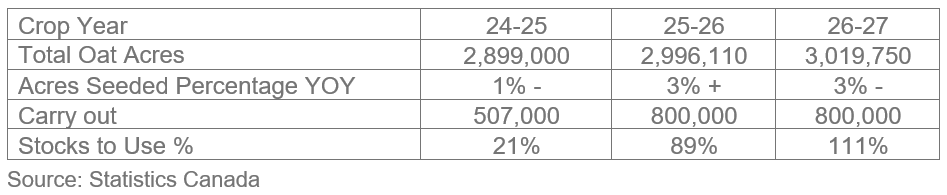
The oat market is quiet. There are a lot of growers, hands in their pockets, pondering next steps. The oat spot markets drifted lower, bottoming out in December. Since then, prices have stabilized.
However, the underlying tranquility may be masking concerns for emerging risks: uncertain weather patterns, questions over future acreage, and other commodity prices. The result is that farmers are waiting until the last minute to make seeding plans.
Seed suppliers are surprised at how quiet seed bookings have been this winter and spring. This could be a result of growers experiencing shortages of cash flow leading to them either cleaning their own oats or even seeding bin run oats. Fortunately for Avena, our oats are grown under the Avena Purity Protocol system, which demands that growers use certified seeds to produce high quality gluten-free oats.
We remain cautiously optimistic about the 2026-27 crop year – there is not a large carryover from 2025-26 and US acres are reported to be down. Once again, we are in a weather market before the crop is even in the ground.
Peas
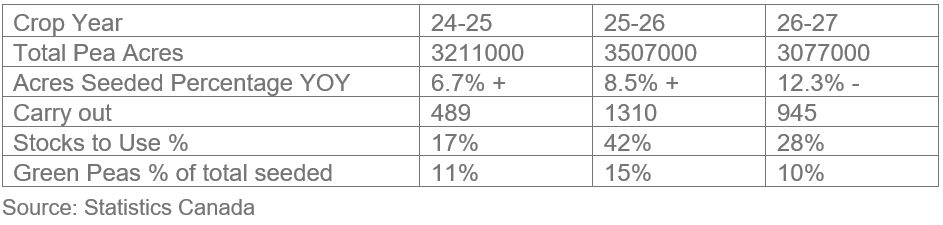
The pea crop story has a few layers to peel back. The 2025 crop acres were up 8.5% from 2024. However, there was a shift in acres from yellow peas to green peas, maybe as high as 15%. (That would mean a decrease of 7 percent in yellow peas from the previous year.) We then need to add to that, six months of tariffs from China. Although there is low pea movement, we have the largest green pea carryover in the past few years.
Although this is not reflected in the Statistics Canada survey last December, I think that this year’s total pea acreage will be similar to last year’s due to higher fertilizer prices and lower commodity prices. This will entice an increase in pea acres.
We also have a pretty good chance of later seeding in the northern half of the grain belt due to the late spring.
Lentils
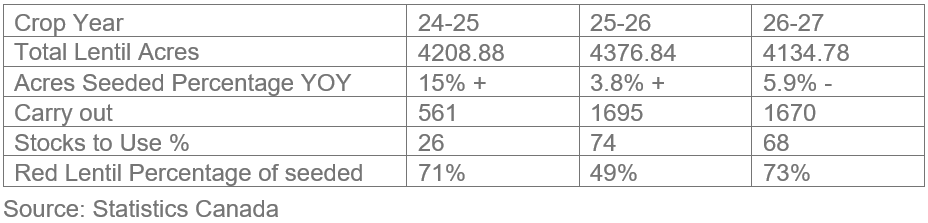
Last year we had a bin buster lentil crop with record high yields. Some growers averaged 75 bushels per acre on large green lentils, which is unheard of. Because of this, though the seeded acreage went up roughly 4%, the carryover went up nearly 50%.
Typically, the red lentil market accounts for 75% of the seeded acres. Last year, with green lentil prices double the red lentil price, we saw a huge swing into green lentil planting. This accounts for most of the carryover.
Carryover of reds is not likely much different from other years. I expect the lentil acreage to be flat; however, I think that we will see a more traditional 70-75% of the seeded acres being red lentils.
Chickpeas
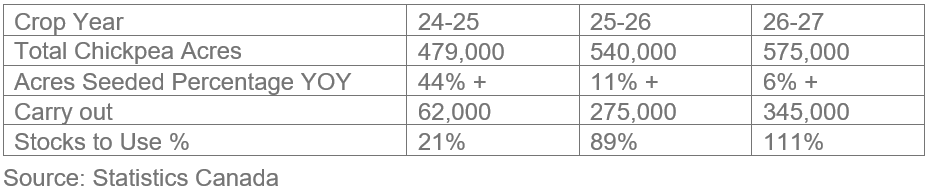
With the exceptionally high stocks-to-use figure on the chart below, I do not see any motivation for farmers to grow chickpeas. Still, the December seeded acre intentions are projecting a 6% acre increase. Barring a weather event affecting this large carryover, prices will be flat or even lower.
Avena has had a busy winter implementing our Avena RegenAg Protocol (ARAP). We are excited to tell you that there are two companies in the market displaying the ARAP logo on their packaging with others soon to launch. Curious? Learn more about ARAP here.
Other news! Avena has joined the Sustainable Agriculture Initiative (SAI) Platform. SAI is a pre-competitive group of 200 plus food companies worldwide committed to accelerating the widespread adoption of sustainable agriculture practices and transforming to sustainable food systems.
We are working with SAI to verify outcomes resulting from regenerative practices of our conventional and certified-organic oat and pulse farmers. These farm practices positively impact soil health, biodiversity, water and climate and deserve to be acknowledged. Learn more about SAI Platform here.
As usual, everything about the crop hinges on weather. Today the soil moisture is adequate – the soil temperature, well, that is another story.
Have a great spring and remember, do as your Momma says: “Eat your Peas!”